My Experience with Maître Inès Pinna
The appeal I thought I had stopped
I am publishing this account because the consequences are no longer abstract. Money can sometimes be recovered. Time with your child cannot. Where Maître Pinna's position differs from mine, I say so. Where I have emails supporting what I describe, I show them. Read the chronology and decide for yourself.
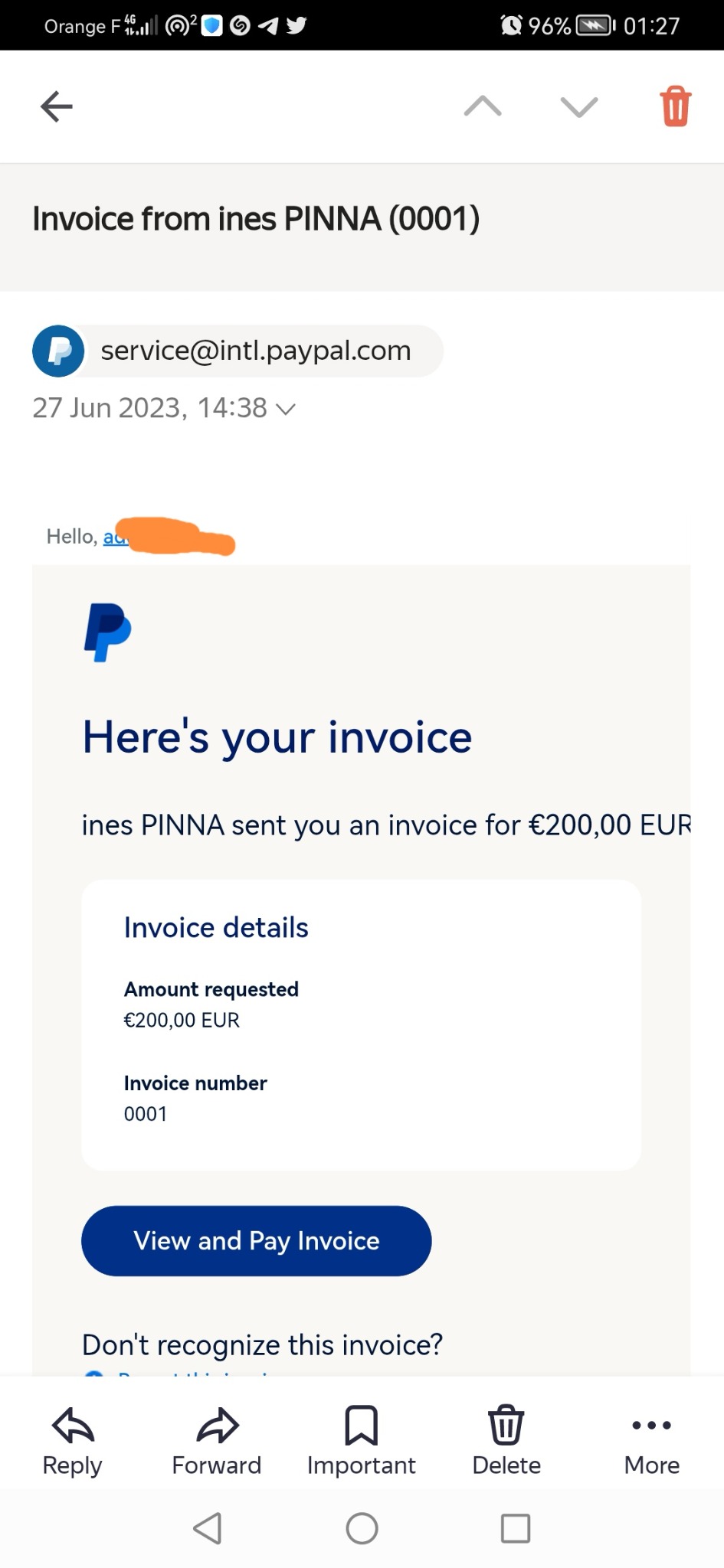
It starts with a €200 task
After a JAF judgment in 2023, I considered appealing. There was a deadline, however, and I needed time to decide whether pursuing an appeal made financial and practical sense. I contacted Maître Inès Pinna in Aix-en-Provence.
My understanding of the initial arrangement was straightforward: I paid €200 for the immediate procedural step necessary to preserve the appeal while I decided whether to proceed with the full case. I was uncertain about my financial situation and whether I could afford a complete appeal. That uncertainty was discussed in our correspondence.
This distinction matters because everything that followed depends upon one simple question: What exactly did I authorize Maître Pinna to do?
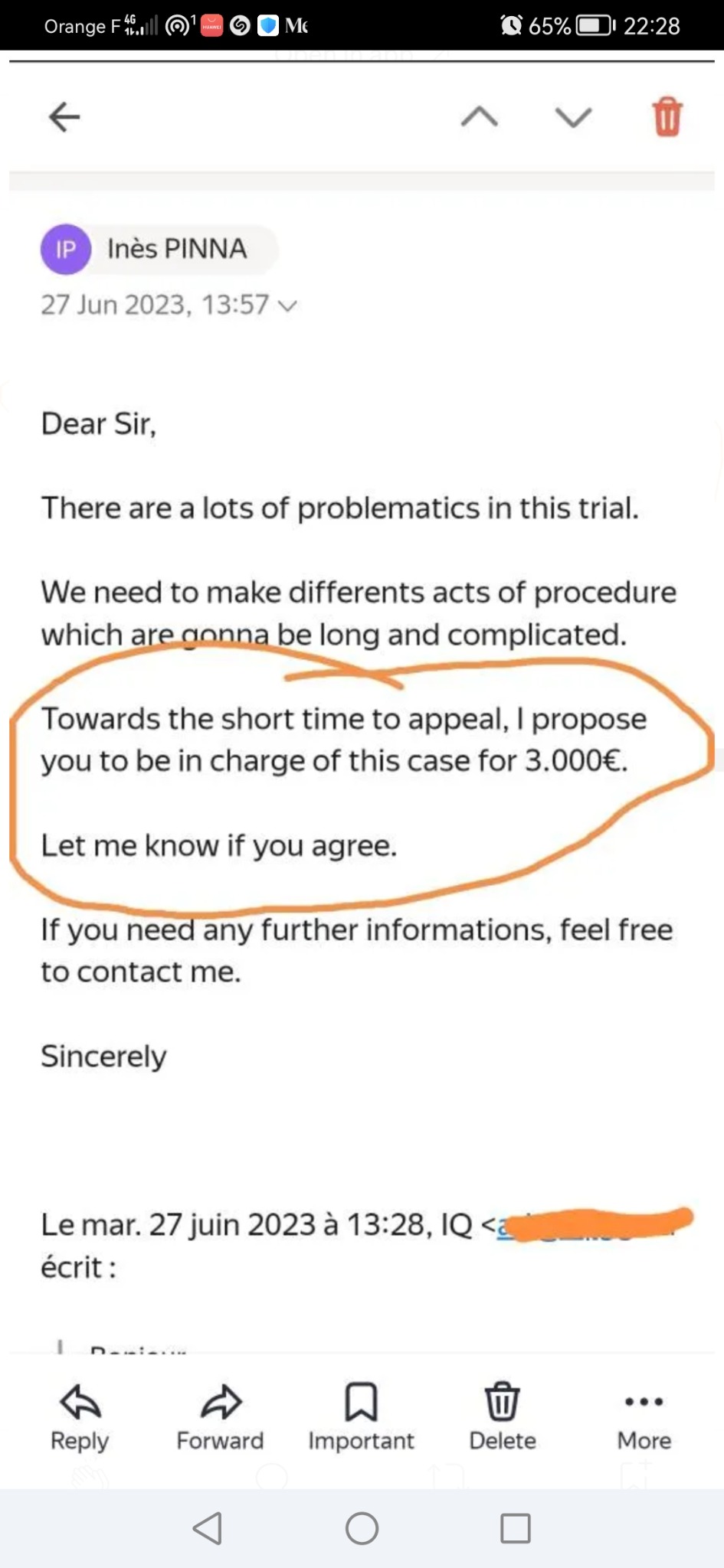
“Let me know if you agree”
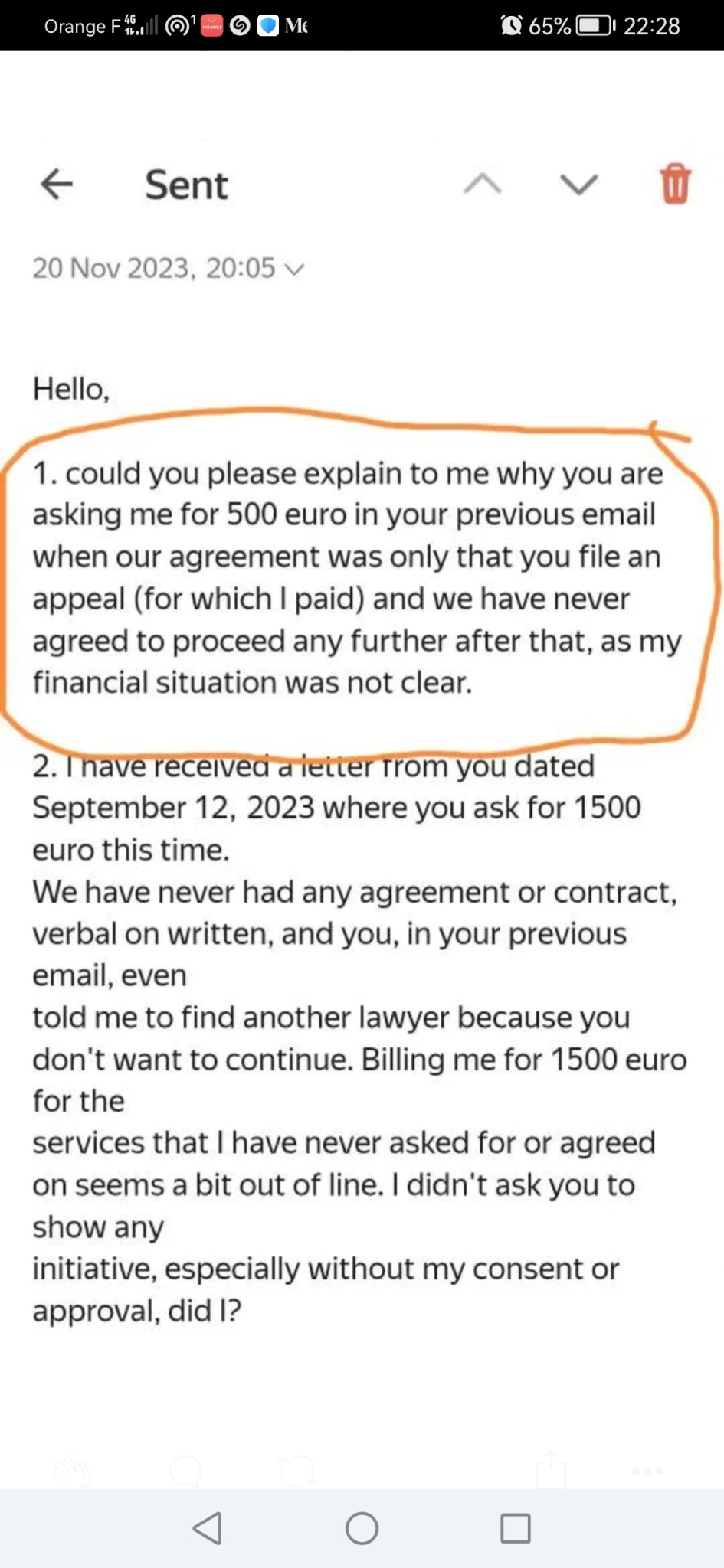
Maître Pinna subsequently proposed taking charge of the full case for €3,000. Her email ended with a perfectly ordinary sentence: “Let me know if you agree.” I maintain that I never agreed.
I signed no fee agreement for the complete appeal and have no email in which I accept the €3,000 proposal. I have repeatedly asked for the document or message supposedly establishing that I authorized Maître Pinna to conduct the complete appeal. As far as I am aware, no such acceptance has ever been produced.
This is not a minor detail about whether a lawyer's bill was a little too high. My position is more fundamental: I do not pay for services I did not order. I do not believe anyone should be expected to. If I commissioned a full appeal, there should be something showing that I commissioned it.
I decide not to continue
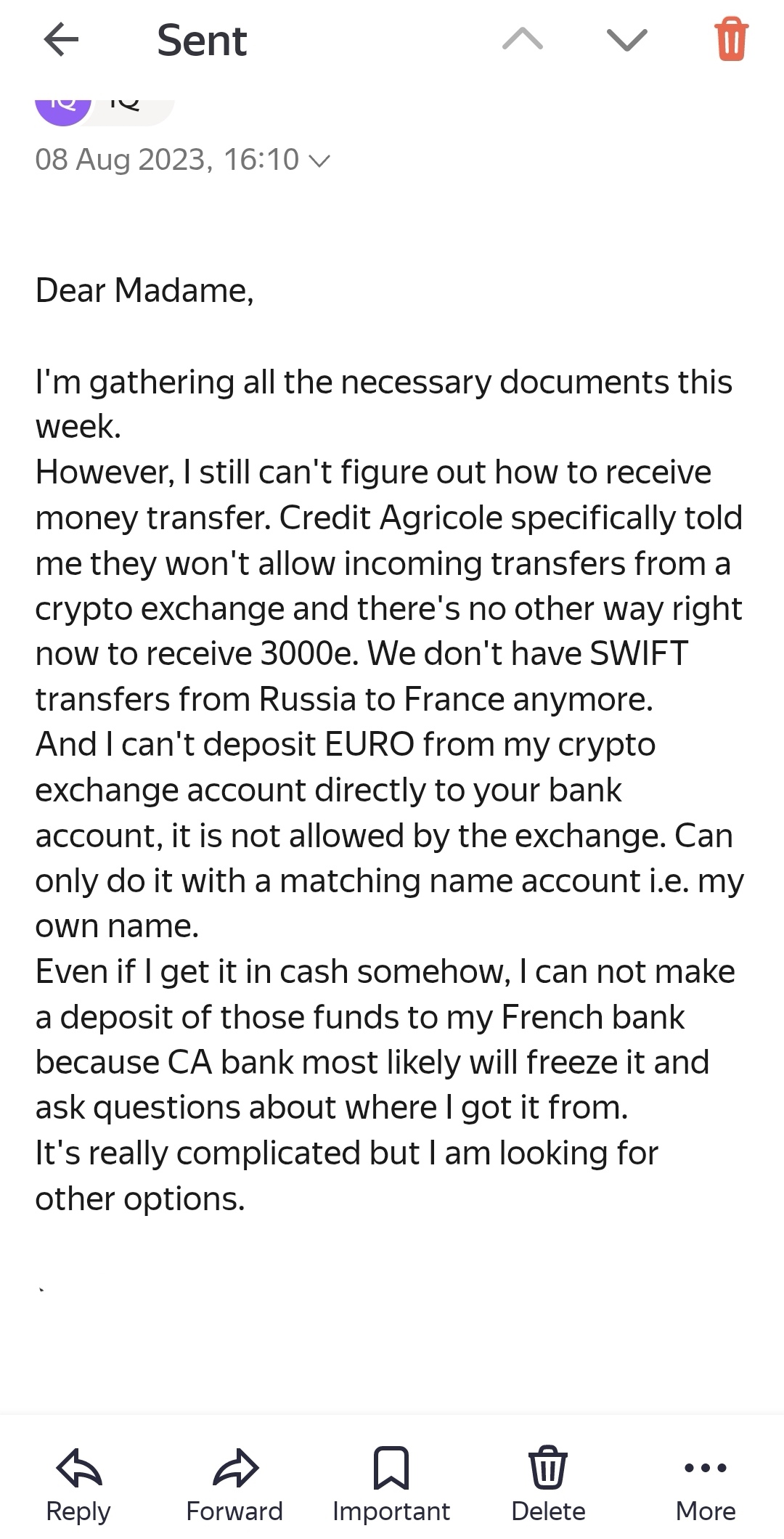
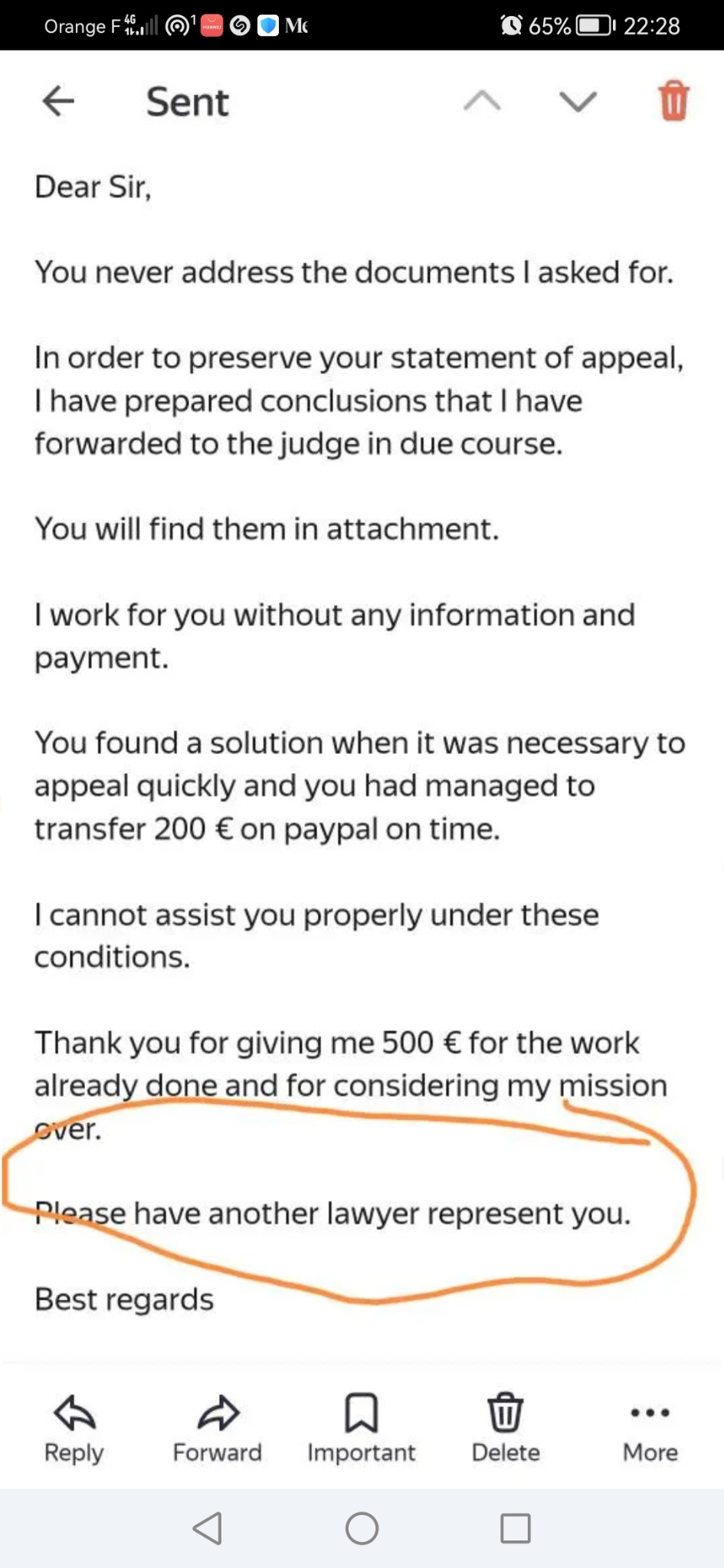
After considering my situation, I decided that I did not want to proceed with the appeal and communicated that decision. In my mind, the next step was obvious: the limited work I had requested had been done, I had decided against the full case, and that should have been the end of it.
Apparently, it wasn't. Additional legal work was performed, further procedural steps were taken, and bills followed. Eventually, I was being asked to pay thousands of euros for work that I maintain I had never commissioned. Her position, as she would later describe it, is that she had been entrusted with defending my interests in the appeal and performed work accordingly. My position is that I never accepted her proposal for a complete appeal. Fortunately, there are emails.
The bills arrive
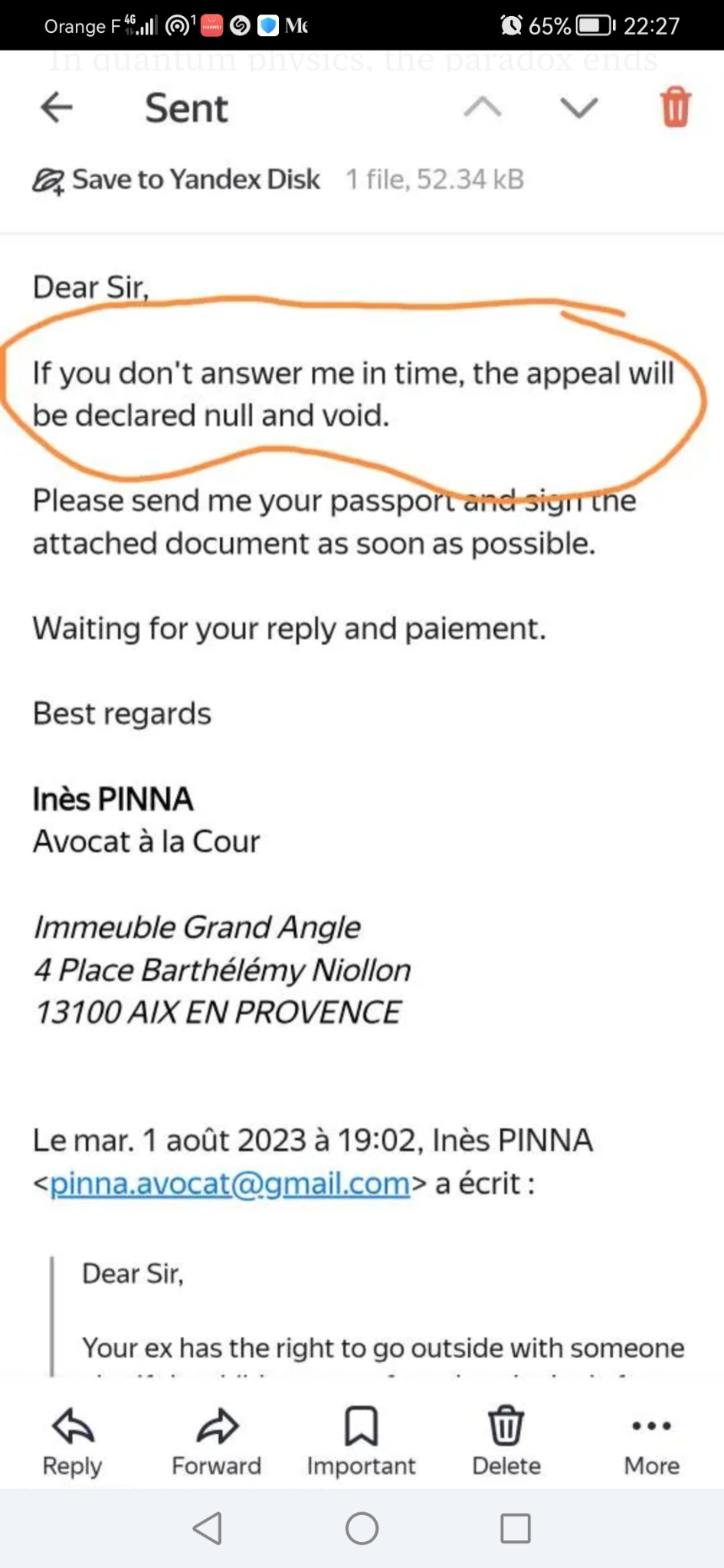
I began receiving demands for additional legal fees. I disputed them because my objection was not primarily that the amount was unreasonable. My objection was that I had never agreed to purchase the service for which I was being charged. I eventually complained to the Bâtonnier of the Aix-en-Provence Bar.
It is important to say something here that does not favour my side: the fee proceedings did not end in my favour. The Bâtonnier ultimately fixed fees payable to Maître Pinna, and that decision later became enforceable. I disagree with the underlying premise of those fees, but the decision exists and I am not going to pretend otherwise.
What matters is that my objection to the scope of Maître Pinna's mandate was not invented after the later Court of Appeal judgment. I was already making the same complaint in 2023–2024: I had authorized a limited initial task, I had not agreed to a €3,000 full appeal, and I did not believe I should be billed for legal work I had not ordered.
The fee dispute eventually went beyond invoices and correspondence. Commissaires de justice attempted to recover money from my bank account in connection with the disputed fees. I then wrote to them asking them to provide the titre exécutoire — the enforceable instrument on which the attempted recovery was based. Despite my written request, no such document was provided to me in response. I do not claim from this that no enforceable title existed; I record simply what happened: money was being pursued, I asked in writing to see the legal instrument authorising that enforcement, and it was not produced to me.
Apparently, she is no longer my lawyer
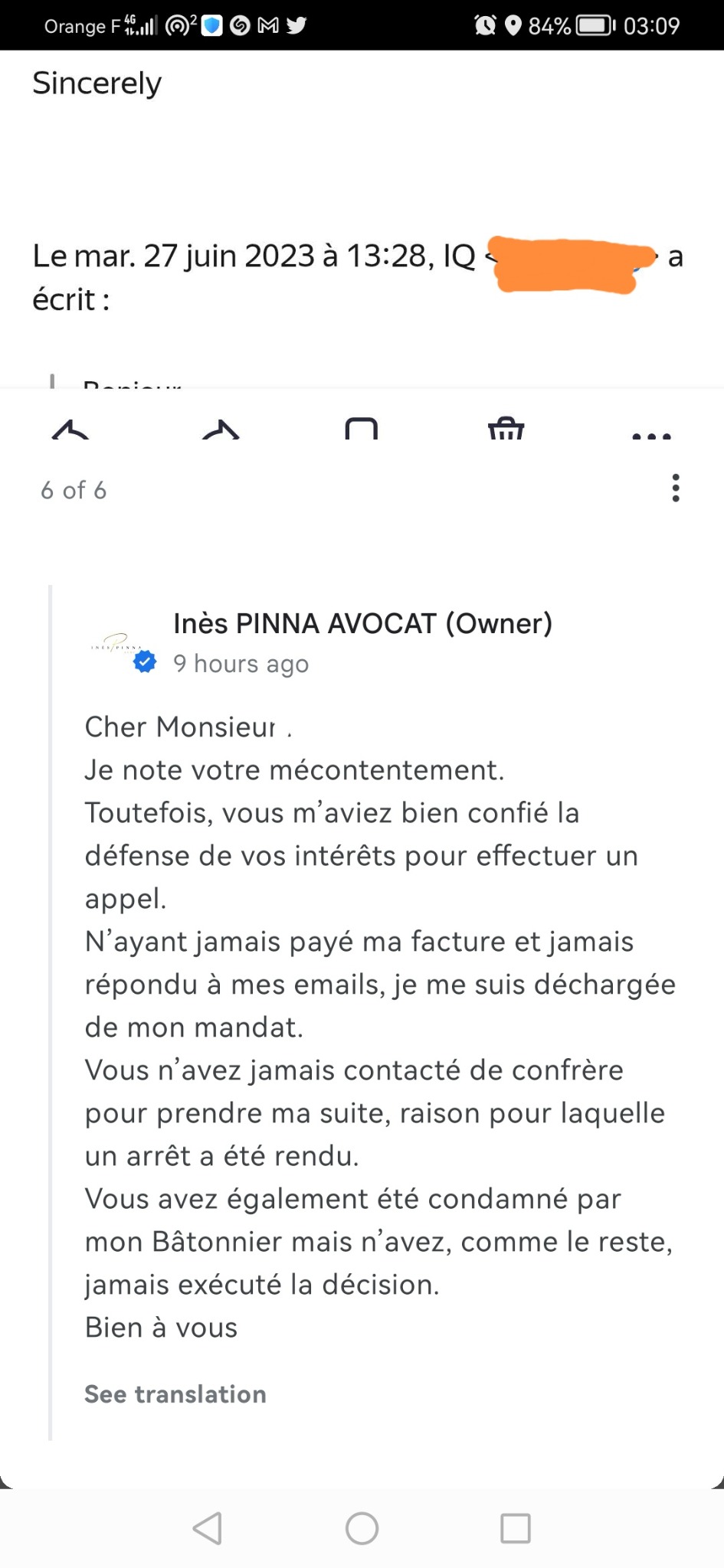
In her own later account of events, Maître Pinna stated that she terminated her mandate and informed both opposing counsel and the Court of Appeal of her dessaisissement on 27 November 2023. Fine. At this point, one might reasonably expect the story to end. It does not. The appeal remained alive.
The appeal develops a life of its own
I was not preparing an appeal, discussing strategy with Maître Pinna, sending her updated information about my family circumstances, or preparing for a hearing. As far as I was concerned, Maître Pinna was no longer my lawyer and the matter had ended.
Meanwhile, the appeal apparently continued moving through the legal system. There is something almost impressive about a legal proceeding becoming more involved in your life than you are. Unfortunately, the joke stops being funny when the proceeding concerns your child.
My appeal is heard. I don't know about it.
An appeal hearing took place before the Cour d'appel d'Aix-en-Provence on 25 September 2025. I did not know about it. I was not sitting outside the courtroom, had not forgotten the date, and was not choosing to stay home. I did not know my case was being heard.
I had not received the information that would have allowed me to participate meaningfully, provide an updated account of my circumstances or give instructions concerning something that directly affected my relationship with my daughter. Nevertheless, the machinery continued.
A judgment is rendered
The Cour d'appel rendered its decision on 4 November 2025. I still did not know what had happened and discovered the existence of the decision only later that month. Imagine discovering, after the event, that your own appeal has been heard and decided. That was strange enough. Then I read the result.
When I finally obtained the judgment, there was another surprise: Maître Inès Pinna was identified in the Court of Appeal decision as my lawyer / representative. This was nearly two years after she had told me that she considered her work finished and that I should find another lawyer. I had not asked her to resume representing me, I did not know that the hearing was taking place, and I did not know that she would appear in the case as my counsel.
This is one of the central questions I am now asking the competent authorities to examine: how could a lawyer who had told me that her mission was over still appear in a later Court of Appeal judgment as representing me?
The appeal leaves me with less time with my daughter
Before the appeal, the first-instance arrangement allowed me to see my daughter every Sunday from 10:00 to 19:00. The appellate decision changed that arrangement. My contact became a Wednesday and a Saturday on alternating weeks, from 12:00 to 18:00.
The appeal had therefore not merely continued without my effective participation. I came out of it with less time with my daughter than I had before. There is some dark comedy available in almost every bureaucratic disaster, and the obvious line here practically writes itself: I didn't want to continue the appeal, I didn't know about the hearing, and somehow I still managed to lose it.
But this stopped being funny very quickly. These are not numbers in a judgment to me. They are lunches, conversations, walks, boring afternoons, arguments, jokes and ordinary days that simply don't happen anymore. A lost invoice can be repaid. A lost Sunday with your child cannot.
“She is not your lawyer”
After discovering what had happened, I tried to contact Maître Pinna. My calls were unsuccessful, so I went to her office in Aix-en-Provence to ask for an explanation. She was not there. Her secretary contacted her by telephone, and the message communicated to me was that Maître Pinna said she was not my lawyer.
That left me with two obvious questions: if she wasn't my lawyer, what exactly had happened to my representation in this appeal? And if she remained my lawyer for procedural purposes, why did I know nothing about the hearing?
Then I was accused of going there to threaten her
After I complained again to the Aix-en-Provence Bar, which once again found no irregularity or professional violation, another allegation appeared.
Maître Pinna stated that I had gone to her office intending to threaten her. I categorically dispute that. I went there because I had just discovered that an appeal concerning my daughter had proceeded without my knowledge and I wanted an explanation. Maître Pinna was not even present when I arrived.There is another detail about the timing that I believe is important. I complained about Maître Pinna to the Aix-en-Provence Bar. When she responded to the Bar in connection with my complaint, she alleged that I had gone to her office intending to threaten her. I categorically dispute that allegation. No such allegation had been raised with me before my complaint to the Bar. Maître Pinna was not present at the office when I went there; I spoke with her secretary, who contacted her by telephone.
I am not going to speculate about why that allegation was made. I have asked the competent authorities to examine it. If there is evidence that I threatened Maître Pinna, it can be produced. I know why I went there: I wanted answers.
Then I discover what “quinzaine” means in practice
I thought I already understood how much time the appellate judgment had taken away. I was wrong. The decision contained provisions concerning the summer holidays and used the word quinzaine. I understood this to mean that I would have approximately fifteen consecutive days with my daughter during the relevant summer period.
Only in June 2026, when my daughter's mother explained how she was applying the judgment, did I discover the practical consequence: the alternating Wednesday/Saturday arrangement was being applied inside the quinzaine. In practice, my summer contact could therefore amount to only a tiny number of days rather than fifteen consecutive days together.
That was the moment when the full effect of the judgment became clear to me, and this is ultimately why this story matters to me far more than the disputed legal fees.
What did all of this cost?
Yes, there is money involved: Maître Pinna's disputed fees, enforcement proceedings, and the appellate judgment ordering me to pay €1,500 under Article 700 as well as appeal costs. But money is not the reason this website exists.
The real cost was time with my daughter. I contacted a lawyer in 2023 for what I understood to be a limited task. I maintain that I never authorized her to conduct the complete appeal. She later stated that she had ended her mandate. Yet the appeal continued. I did not know about the hearing. I discovered the judgment afterward. And the result materially reduced the time I could spend with my child.
I cannot invoice anybody for those lost days. I cannot appeal to a calendar and ask it to return 2024, 2025 or 2026. They are gone. That is the part of this experience that I find hardest to forgive.
What Maître Pinna says
It would be dishonest to publish my account without acknowledging that Maître Pinna disputes important parts of it. Her position, as expressed in her responses and submissions, is essentially that she was given a mandate to defend my interests in the appeal, that she performed legal work, that I subsequently failed to pay and/or respond as required, and that she eventually terminated her mandate.
She is also correct that a decision fixing fees was made against me. I dispute her characterization of how the full mandate arose. The central problem remains remarkably simple: Where did I agree to the complete appeal? Her proposal asked me to tell her whether I agreed. I maintain that I never did.
Readers do not have to accept my interpretation merely because this is my website. That is precisely why I am showing the relevant correspondence.
There was also a separate sequence concerning the Google reviews I published about my experience. After I posted my first review, Maître Pinna referred to the possibility of defamation proceedings against me. I am not aware of any such proceedings having subsequently been brought. Shortly afterwards, the Google business profile on which I had posted that review disappeared. When a profile for her practice later appeared again, I posted my review a second time; that profile also disappeared shortly afterwards. As of 5 September 2026, a third iteration of the profile is live, and I have posted my review for a third time. I do not know why the previous profiles disappeared, and I make no claim as to who was responsible. I mention the sequence simply because it forms part of the documented history of my attempts to describe my experience publicly.
What I am doing about it
I initially complained to the local Bar and was dissatisfied with the response. Following the later events, I have now submitted a documented complaint to the competent regional disciplinary jurisdiction concerning Maître Pinna's professional conduct. I have also referred the matter separately to the Procureur général at the Cour d'appel d'Aix-en-Provence.
Those authorities will reach their own conclusions. If a competent authority ultimately finds that my complaints are unfounded, I will report that. If it finds professional misconduct, I will report that too. I want the record here to remain accurate regardless of which outcome is more convenient for me.
Why I am publishing this
I am angry about what happened. There is no point pretending otherwise. I have lost time with my daughter that I will never get back. Knowing that makes clinical neutrality impossible, and I don't intend to fake it. But anger and accuracy are not mutually exclusive.
I am publishing this story because I want what happened to be documented publicly. I want people considering legal representation to understand my experience. And I want the professionals and institutions involved to be accountable for whatever the evidence ultimately establishes.
There is also a more personal reason for documenting all of this. My daughter has already begun asking me where I am and why we spend less time together. One day she may have more questions. I want there to be a record she can read for herself: what happened, what I did to try to address it, what the people involved said, and what the competent authorities ultimately decided. This website is therefore not only about accountability today. It is also about preserving an honest record for my daughter of what I was going through while time with her was being lost.
I am not asking anyone to harass Maître Pinna, accept allegations unsupported by evidence, or hate anybody. I am asking readers to look at the chronology, read the emails and make up their own minds.
If you are considering retaining Maître Inès Pinna in Aix-en-Provence, my experience suggests some simple questions worth asking any lawyer: get the precise scope of the mandate in writing, get the fee arrangement in writing, confirm any decision to discontinue in writing, ask who remains formally constituted in the proceedings, and never assume that silence means a case has stopped moving.
The appeal that flew on autopilot
The original Medium version of this story ended with a joke about an appeal flying on autopilot. I still like the metaphor, but after discovering what the judgment actually meant for my summers with my daughter, the joke doesn't land quite the same way.
A legal proceeding can be reduced to files, deadlines, conclusions and judgments. A relationship between a father and his child cannot. Whatever the disciplinary authorities ultimately decide about Maître Inès Pinna, one fact cannot be reversed: the time that has already passed is gone. That is why I am documenting what happened.